.jpg)
Introduction to Quantum Biology
Soon after quantum mechanics was developed in the 1920s, physicists began to speculate about whether these new laws could be used to explain one of science's most persistent mysteries: the phenomenon of life. Over the subsequent decades, Erwin Schrödinger explained how the discrete nature of chemical bonds posited by quantum theory underpins life and scientists experimentally identified the first quantum biological effect: electron tunneling as part of enzyme catalysis.
Many scientists, however, conjectured a much larger role for quantum mechanics in biology. The three most prominent lines of research have focused on the efficiency electron tunneling may lend to photosynthesis and mitochondrial function, the possibility that consciousness depends on the entanglement of particles in microtubules in the brain, and, most famously, the proposal that birds navigate using a quantum compass that allows them to sense the Earth's magnetic field.
Even these lines of research may understate the degree to which life depends on the laws of quantum mechanics. Biology remains one of science's most persistent puzzles. It stands to reason that there might be clues to that puzzle hidden within the one of science's most thoroughly tested, yet poorly understood theories. The field of quantum biology seeks to identify quantum phenomena in biology and thereby determine the degree to which life is, or is not, itself a quantum phenomenon.
.jpg)
Investigation of the RPM
Magnetic fields are known to have impacts in both chemical and biological contexts, though the precise mechanism is often unknown. One popular explanation, from the field of quantum biology, is the "radical pair mechanism" (RPM), a quantum-chemical mechanism by which magnetic fields alter the rates of chemical reactions. Learn about Leverage's attempt to rule the RPM in or out as an explanation of magnetobiological effects, as well as some of the discoveries made along the way.
Resonance points in RPM models
The radical pair mechanism (RPM) pertains to a quantum property of electrons known as "spin." When pairs of electrons are subjected to magnetic fields, their spin states change. Because the spins of electrons determine whether they can or cannot form chemical bonds of certain types, magnetic fields can alter the rates with which chemical reactions take place. This phenomenon became known as the "radical pair mechanism."
Originally identified in 1969, the RPM was first used to explain the magnetosensitivity of chemical reactions in the context of nuclear magnetic resonance. Subsequently, the RPM has become the accepted explanation for the magnetosensitivity of chemical reactions, with experimental results agreeing with the predictions of theory.
In 1978, the RPM was proposed as the mechanism underlying the ability of birds to navigate using the Earth's magnetic field. In the decades since, researchers have tried to determine more about the biological mechanism, as well as whether the RPM is, in fact, a significant causal factor in magnetobiology. Despite some progress, the issue is currently undecided and alternatives to the RPM have been proposed.
Learn more about the RPM's history, how it works on a physical and chemical level, how it can be studied, and open questions on the topic. >>

Biologist-friendly mathematics of the RPM
The radical pair mechanism (RPM) involves the effect of two magnetic fields on the spin state of a pair of electrons. The mathematics of electron spin, a quantum phenomenon, is complex, involving imaginary numbers and, when multiple electrons are involved, higher dimensional spaces. As a result, the radical pair mechanism itself, as well as the different observable spin states of electron pairs, are often difficult for non-specialists to understand.
In a non-biological context, the entire apparatus of quantum mechanics may be necessary. Within biology, however, it is plausible that only one measurement of the spin state of an electron pair occurs prior to the spin state being randomized. If that assumption holds, the mathematics can be simplified.
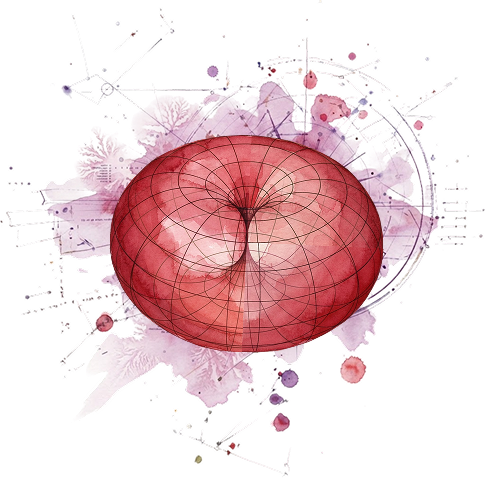
Rather than a seven-dimensional sphere, electron pair spin states can be represented using a probability distribution spread across a torus (i.e., the surface of a donut-shaped space). Uniform magnetic field effects become circular motions on the torus, while non-uniform magnetic field effects become deviations from a circular motion. The observable spin states (S₀, T₊, T₀, and T–) receive a natural interpretation and the special role of the singlet state is highlighted.
<<Learn about a representation of the RPM designed for use especially in biological contexts, which may be more intuitive than seven-dimensional spheres or arithmetic involving imaginary numbers. >>
Field Building in Quantum Biology
Leverage publishes reports on many topics in science and technology, including case studies on major discoveries in the history of science, analyses of bottlenecks in existing fields, as well as research from our own foundational research programs.
%20-%20jpg%20thumbnail.jpg)